
Employment Law
Labour Commissioner Complaint Process for Wrongful Termination
How Labour Commissioner and labour department pathways work in India after wrongful termination—jurisdiction, filings, conciliation, and preparation tips.
When a legal notice fails or the employer refuses dialogue, many employees look to the Labour Commissioner or state labour department machinery. These pathways are designed to be more approachable than full trials—but they still reward preparation. This guide explains what the process typically looks like, who it fits best, and how to avoid procedural misfires that cost months.
Who this path usually fits
Labour department interventions are most natural for workmen and employees seeking unpaid wages, notice pay, or intervention around unfair exits in covered establishments. Senior managerial personnel with purely contractual disputes may be steered toward civil remedies instead. Classification disputes are themselves common—employers argue “manager,” employees argue “workman.” Your actual duties, not just a fancy designation on the visiting card, influence that analysis.
Typical stages
- Pre-complaint: collect documents, send notice, calculate dues
- Filing: submit complaint in the prescribed form or portal with annexures
- Scrutiny: office may seek defects rectification or additional papers
- Notice to employer: opposite party is called for response
- Conciliation or joint meetings: settlement exploration
- Failure report or forward path: escalation to labour court or tribunal where applicable
- Orders or settlement recording: document every outcome in writing
What to put in the complaint
Write like an auditor. Identify parties, employment tenure, last wages, termination facts, legal grounds, and precise relief. Attach the appointment letter, termination communication, notice copy with postal proof, payslips, and bank statements showing non-payment. If colleagues faced similar exits, resist turning your complaint into a class action unless you have advice—stick to your cause of action while noting pattern facts carefully and truthfully.
| Relief sought | When it fits | Preparation tip |
|---|---|---|
| Notice pay and wage dues | Contract or statute ignored on exit | Itemise month-wise |
| Intervention for unfair dismissal | Workman plus unfair labour practice narrative | Emphasise duties and process gaps |
| Documents such as relieving letters | HR withholding letters | Show written requests |
| Conciliated settlement terms | Both sides want closure | Draft term sheet in advance |
Conciliation realities
Conciliation is not a courtroom drama. Officers often push pragmatic mid-points: partial payments, neutral experience-letter language, withdrawal of allegations. Attend every date. Bring authority to settle or a clear written mandate from whoever decides. If you refuse a low offer, do so politely and on reasoned math. If you accept, ensure the settlement records timelines for payment and document issuance, plus consequences of default.
Parallel tracks and pitfalls
Avoid filing contradictory cases with inconsistent facts in multiple forums without strategy. Do not skip employer notice if your local practice expects pre-litigation demand. Watch limitation and attendance—repeated absence can sink momentum. Keep communications with the opposite party civil; new WhatsApp insults become opposing exhibits faster than you expect.
Hearing-ready checklist
- Confirm correct labour office or portal for your establishment location
- Align complaint facts with your earlier legal notice
- Paginate and index annexures
- Carry identity proof and employment IDs to hearings
- Prepare a settlement floor and ceiling before the first joint meeting
- Diary next dates the same day you receive them
Using LawGPT to prepare the file
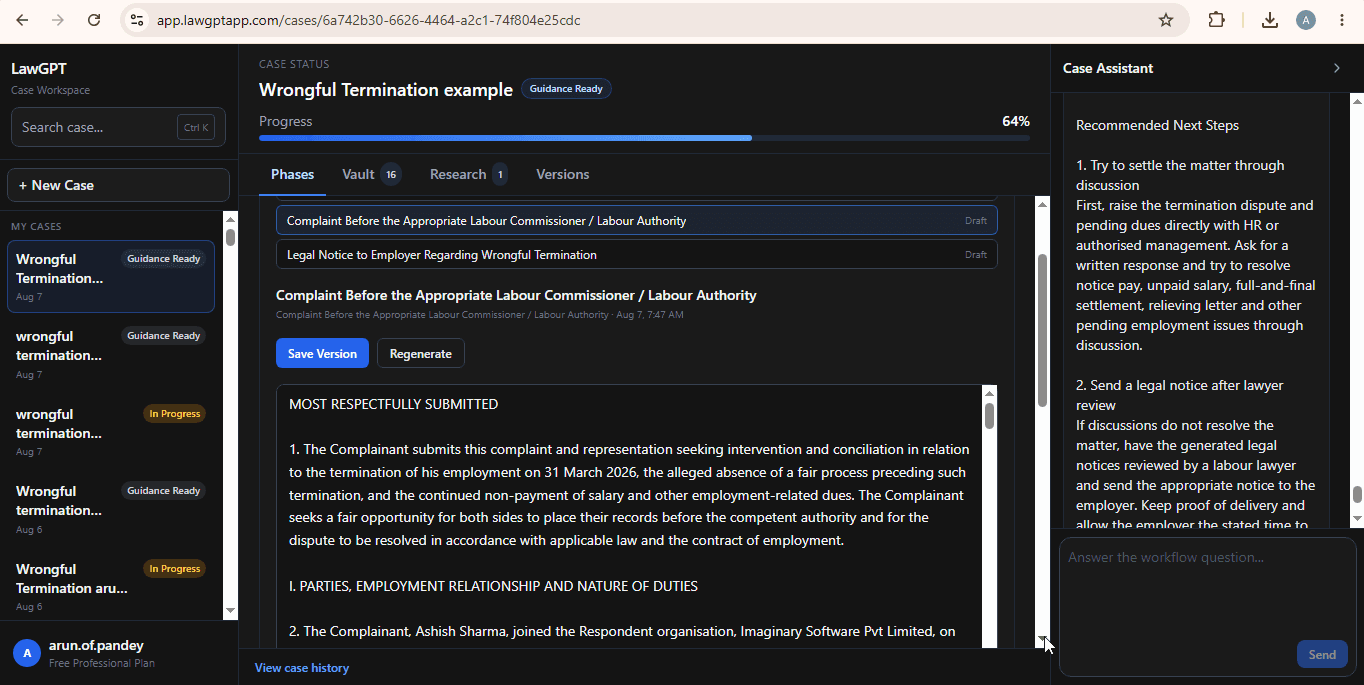
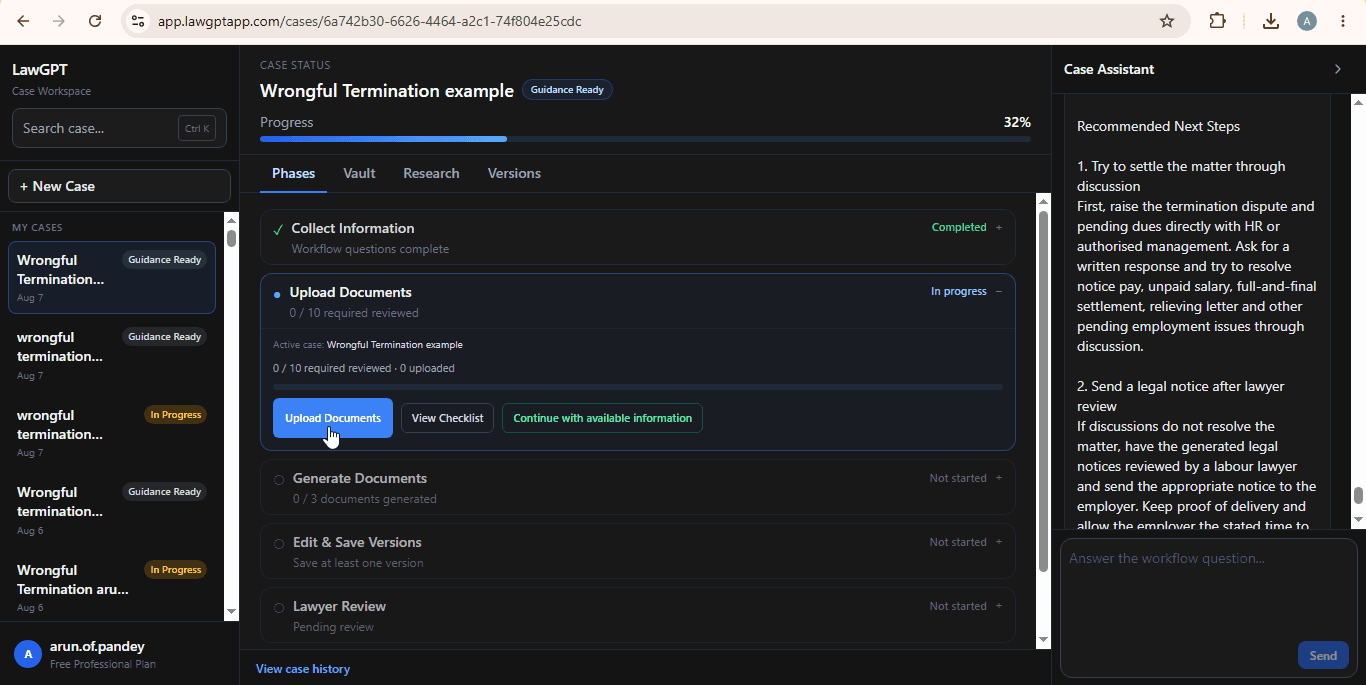
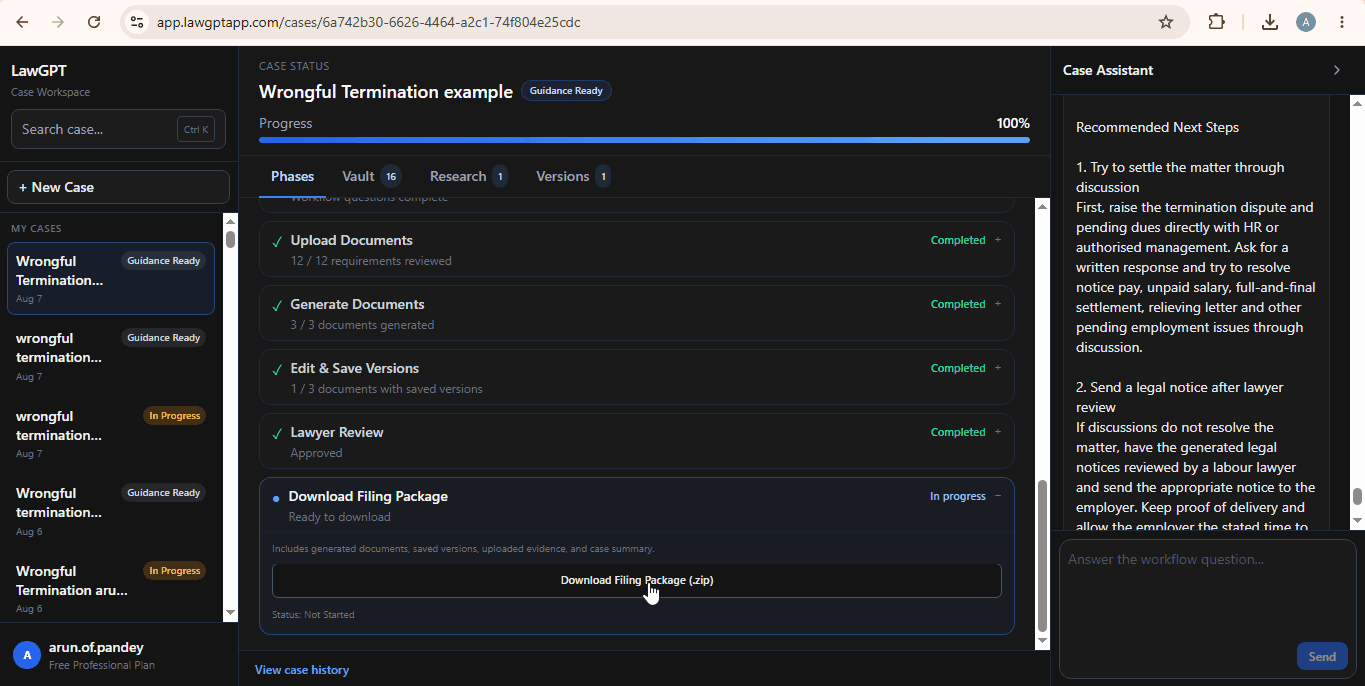
The /workflows/wrongful-termination journey helps you generate a Labour Commissioner complaint draft that matches your case summary and evidence map, then download a package you can review with counsel. Explore /platform if you need research context on process or a lawyer pass before filing. Software accelerates structure; local procedure still requires your verification on forms, fees, and jurisdiction.
Success is less about dramatic speeches and more about consistent papers, attendance, and credible numbers. Treat the Labour Commissioner pathway as a project with milestones, not a single visit that magically produces a cheque.
Online portals versus physical filing
Indian states have unevenly digitised labour grievance systems. Some offers online registration with tracking numbers; others still revolve around physical submission and inspectorate diaries. Before you travel, check the labour department website for your state and the establishment’s local jurisdiction. Carry both digital PDFs and printed sets. If a portal times out, keep screenshots of the error and try physical filing rather than waiting indefinitely for IT fixes.
When forms ask for “nature of dispute,” be specific: non-payment of notice pay, illegal termination without enquiry, withholding of relieving letter, unpaid wages for named months. Vague descriptions like “harassment” without wage or termination particulars can send your matter into a less useful queue. Attach the appointment letter and termination communication even if the form has no perfect field for them—use annexures.
What officers can and cannot do
Labour department officers can often summon parties, encourage settlement, and process certain statutory claims. They are not always a substitute for a labour court award on complex unfair dismissal theories. Understanding that boundary prevents disappointment. If conciliation fails, ask what formal next step is recorded—failure report, referral pathway, or advice to approach a specific forum—and obtain whatever writing the office issues.
Employer tactics during conciliation
- Claiming you are not a workman based solely on designation
- Producing a resignation letter obtained under pressure
- Offering a tiny ex gratia in exchange for a broad release
- Delaying dates while dangling partial payments verbally
Counter designation arguments with duty evidence. Counter resignation narratives with contemporaneous protest emails. Counter tiny offers with your dues sheet. Counter verbal dangling with “please email the offer.” Conciliation rewards the prepared.
Building a settlement term sheet in advance
Walk into the first joint meeting with a one-page term sheet: amount, payment date, mode, experience letter wording, withdrawal of allegations, and mutual non-disparagement if any. You can negotiate down from a target, but starting with no paper makes it easy for the other side to control the draft. If you settle, ensure the labour office records the settlement appropriately where that is the practice.
LawGPT’s complaint and package tools at /workflows/wrongful-termination help you arrive with indexed annexures rather than a plastic bag of loose prints. Optional review on /platform is valuable when the employer brings counsel to conciliation and maintainability objections start flying. Procedure is local; preparation is universal.
Evidence presentation that officers can skim
Labour offices see crowded boards. A ten-page narrative without an index loses to a three-page complaint with a chronology and ten clean annexures. Put employee ID, joining date, last working day, and last wages on page one. Put the prayer list on page one or two. Do not bury the ask. If you allege forced resignation, place the protest email immediately after the resignation letter annexure so the officer sees both in one motion.
Bring two complete sets plus your personal working copy. Mark your working copy with sticky tabs for contract clause, termination letter, and dues sheet. When the employer produces a surprise document, ask for a copy and a short adjournment rather than arguing from memory. Calm process points often impress more than raised voices.
After a failed conciliation
Ask what writing you will receive and what forum is next. Note the date of failure recording. Consult whether industrial adjudication, a wage claim route, or civil notice is the correct continuation for your classification. Do not treat failure as the end—treat it as a documented milestone that proves you tried statutory conciliation where expected. Update your LawGPT matter notes so the next draft references the conciliation history accurately.
Coordinating counsel and self-representation
Many employees begin the labour pathway alone and later add counsel when the employer arrives with a panel firm. That transition works if your file is already indexed. Hand over the chronology, annexure list, notice, and dues sheet on day one of engagement so fees go to strategy rather than archaeology. If you remain self-represented, practice a three-minute oral summary: who you are, what happened, what you want. Officers respond to clarity. Bring a relative for support if needed, but decide who speaks so the session does not become a chorus of contradictions.
If a union or employee collective exists at your establishment, understand whether your dispute is individual or part of a wider industrial issue. Individual notice-pay claims usually stay individual. Broader unfair labour practice patterns may benefit from collective context—but do not let your personal dues become a hostage to a slower group agenda without your informed consent. Keep LawGPT matter notes updated at /workflows/wrongful-termination so any later counsel inherits one spine of facts.
Inside the LawGPT workflow
Frequently asked questions
Often yes for labour department complaints, though representation helps when the employer brings counsel or raises complex maintainability objections. Procedure literacy still matters.