
Consumer Law
Consumer Complaint FAQ (India)
Straight answers to common questions about consumer complaints, commissions, refunds, e-commerce disputes, and evidence under Indian law.
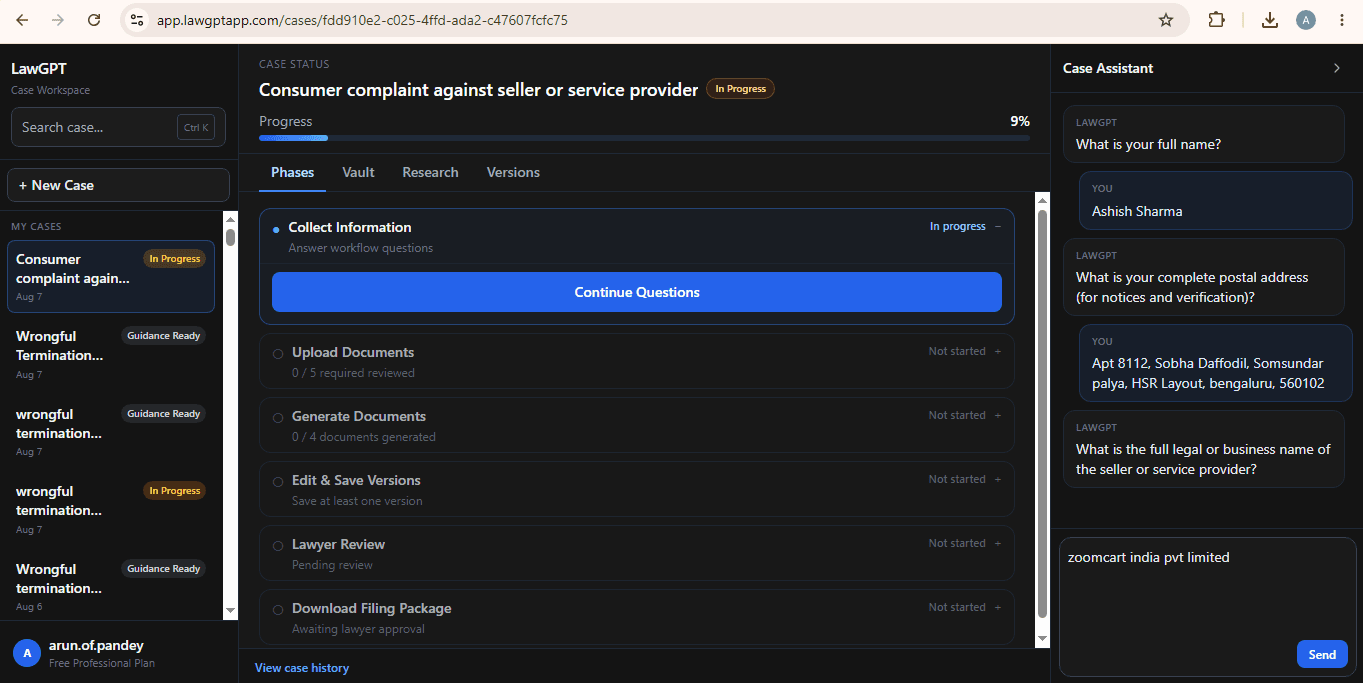
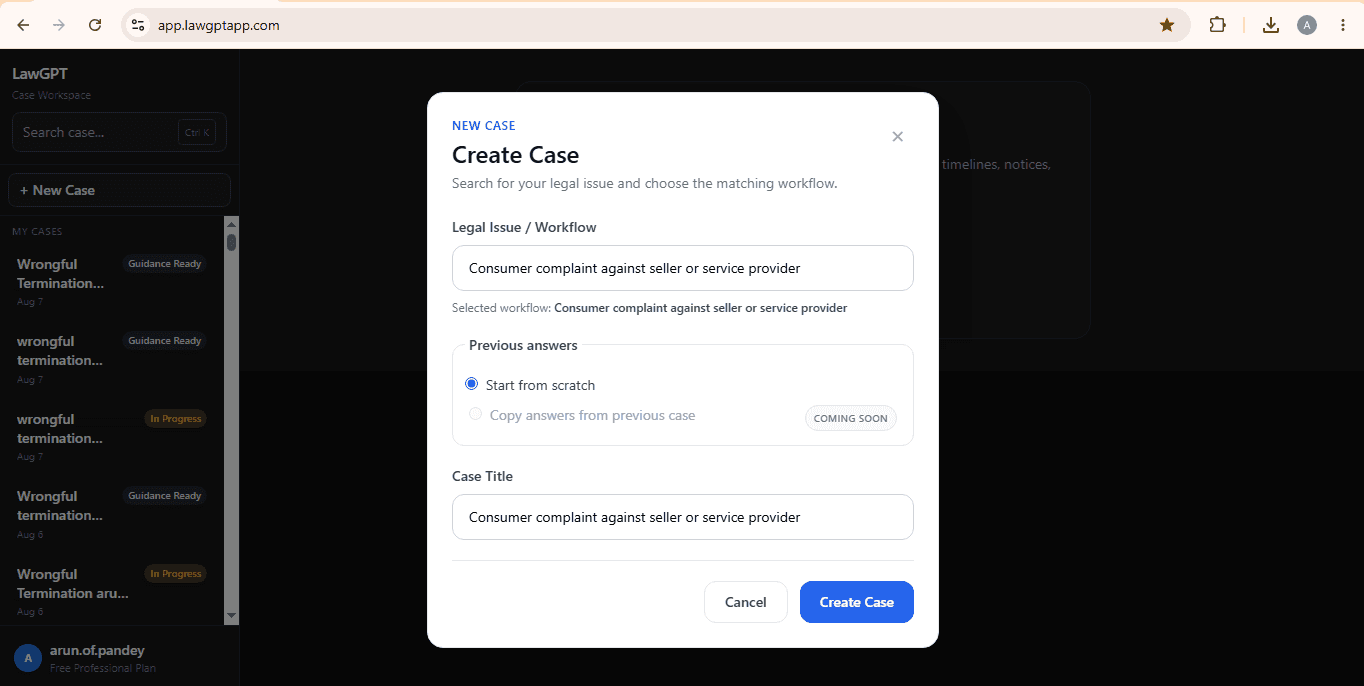
Consumer complaint workflow walkthrough · 3 min · plays inside LawGPT
This FAQ gathers the questions consumers ask most when a refund stalls, a product fails, or a service falls apart. Answers are practical education for India—not a decision on your facts. For high-value or multi-party disputes, verify pecuniary limits and entity names before filing.
Who can file?
Typically a consumer who buys goods or hires services for consideration. Purchases exclusively for resale or purely commercial bulk purposes may fall outside. Beneficiaries and certain recognised consumer associations can appear in defined situations. When your start-up buys tools for business use, analyse consumer status carefully rather than assuming either extreme.
Where and how much?
District, State, and National commissions split by claim value rules. Territorial links follow business location and cause of action—including many online purchase patterns. Recheck current thresholds; do not rely on outdated blog numbers.
| FAQ theme | Short answer | Read next |
|---|---|---|
| Refunds stuck | Escalate with UTR-level demands | refund-not-received |
| Process stages | File → notice → mediate → evidence → order | consumer-commission-process |
| Documents | Invoice + promise + breach + tickets | consumer-complaint-documents-required |
Notice, lawyers, and costs
A legal notice is often smart even when not strictly mandatory. Lawyers are optional but helpful for complex pleadings. Filing fees exist on a slab basis—budget for them. Seeking inflated compensation without proof can hurt credibility more than it helps negotiation.
Evidence myths
You do not always need a laboratory. You do need a coherent bundle. Unboxing videos are not mandatory but are powerful. Chat screenshots without payment proof are weak; payment proof without the promise is also incomplete.
FAQ quick actions
- Export chats and invoices today
- Write a one-page chronology
- Email grievance contacts with a deadline
- Calculate a realistic claim value for tier selection
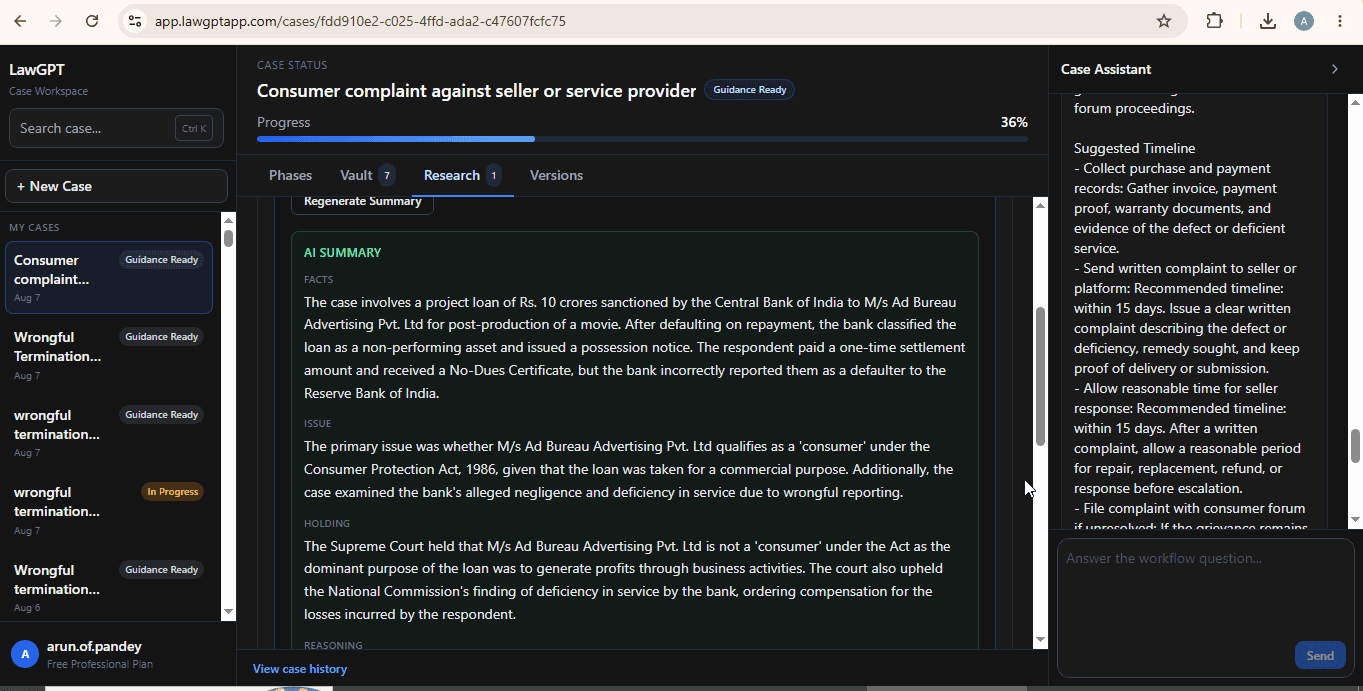
- Use /workflows/consumer-complaint to structure drafts
- Consider /platform review for multi-party e-commerce fights
Settlement questions
Yes, you can settle after filing. Get the refund mode and date in writing. If you accept store credit, do so consciously. Withdraw or dispose of the complaint on consented terms so it does not linger.
For deeper narrative guides, start with the complete guide, then the commission process and documents checklist. Those three cover most consumer journeys before niche sector regulators enter the picture.
Filing mechanics—rapid answers
You generally file before the competent consumer commission with pecuniary and territorial jurisdiction. E-filing exists in many places but not uniformly. Fees depend on claim slabs. Affidavits verify facts. Incomplete annexures cause defect memos—cure them quickly. You can often appear in person; authorisation rules apply for representatives. None of this requires memorising the entire Act; it requires reading the local filing checklist once.
If your complaint is returned with defects, treat that as editing, not defeat. Many first filings need pagination or fee tweaks. Keep the acknowledgment trail.
Opposite parties—rapid answers
Name who invoiced you, who manufactured a defective good when relevant, who ran the marketplace checkout, and who denied the refund. Trade names are not enough. GSTIN and legal pages help. Over-naming random logistics interns is unhelpful; under-naming the payment entity is fatal to easy recovery.
Money outcomes—rapid answers
- Refund of price is the core ask in many cases
- Replacement is natural for defects when you still want the product type
- Compensation must be reasoned and proportionate
- Costs can be sought when you were forced to litigate unpaid refunds
Settlement can mix these outcomes. A partial refund plus replacement is not unusual. Get the mix in writing.
After you win—rapid answers
Certified copies matter. Compliance deadlines matter. Execution exists when businesses ignore orders. Appeals have clocks. Do not assume a PDF order emailed by a friend is enough for execution—follow local certified copy practice.
When FAQ-level answers are not enough, read the complete guide and commission process next, then structure your matter in /workflows/consumer-complaint. For edge cases—cross-border sellers, medical services, unfair contract clauses—use /platform review before you lock prayers.
Strategy choices—rapid answers
Start with platform tickets for speed, but diary a legal clock. Use notices when tickets loop. File when deadlines expire or sellers vanish. Mediate when the offer approaches your floor. Appeal only with a clear legal error or evidentiary miscarriage worth the cost. Most consumers need the middle of that menu, not the extremes of endless chatting or immediate maximalist litigation.
If your dispute is under a few thousand rupees, weigh time cost honestly. Sometimes a precise notice still works because companies automate risk. Sometimes you walk away. Rights include the right to choose which battles consume your week.
Credibility—rapid answers
Tell one story. Keep screenshots unedited except for highlighting. Disclose partial refunds. Do not invent medical harm. Do not threaten influencers casually. Commissions have seen everything; they reward proportion. LawGPT can help you keep the story structured at /workflows/consumer-complaint, but credibility remains a human asset you protect daily while the case runs on /platform tools and hearings.
Business buyers and mixed-use purchases
Laptops bought for a home office, phones used for work chats, and software seats for a tiny proprietorship create grey zones. Facts about predominant use matter. Disclose honestly. Pure inventory purchases for resale are usually the weakest consumer stories. When in doubt, gather use evidence before you assert consumer status in a pleading.
Appeals and second chances—rapid answers
An adverse order is not always the end. Appeal windows are short—diary them the day you receive the order. Sometimes curing a maintainability defect and refiling is smarter than appealing. That choice is strategic; get advice if the principal is large. For small matters, evaluate whether more procedure is worth your time after a full hearing on evidence.
Also remember that a consumer win against an insolvent shell company may be hard to execute. Party selection at the start is worth more than brilliant arguments at the end. That is why earlier guides emphasise invoices and legal names—and why structured intake in /workflows/consumer-complaint asks who took your money before it asks how angry you are.
Myths that waste months
Myth: police will recover your refund next week for ordinary e-commerce failure. Myth: you must wait one year before filing. Myth: consumer commissions always finish in thirty days. Myth: a marketplace can never be named. Myth: verbal agent promises override written policy without proof. Replace myths with dated escalation and documents. The FAQ answers across this hub exist to shorten the myth phase so you can reach the evidence phase faster.
When you are unsure whether a myth is shaping your plan, write your next three actions with dates. If an action is “wait for them to do the right thing” without a deadline, rewrite it. Deadlines are how rights become real inside Indian consumer procedure—and how LawGPT matter timelines on /platform stay honest.
Practical “should I file?” filter
File when the principal is worth your time, the evidence pack exists, the opposite party is identifiable, and internal escalation has failed or become futile. Pause when you are missing the invoice and can still obtain it, when a written settlement offer clearing your floor is days away, or when a specialised regulator will clearly get you faster relief for a narrow issue. The filter is not moral—it is operational. Consumer rights include the right to choose efficient enforcement.
If you pass the filter, do not delay for perfect confidence. Organised filing beats perfect hesitation. Use the complete guide, documents checklist, and /workflows/consumer-complaint to move from FAQ browsing to a dated package. Optional /platform review is for edge maintainability questions, not for postponing a straightforward unpaid refund forever.
If you remember only one FAQ answer, remember this: dated evidence plus a clear ask beats outrage. Outrage without exhibits delays refunds. Exhibits without an ask confuse agents and commissions. Put both in writing, then use a structured workflow to keep them aligned through notice and filing.
Keep this FAQ hub bookmarked, but move to action within a week of starting research. Reading every guide without freezing evidence is its own delay pattern. Education first, then artefacts—invoice exports, notice drafts, and a filing decision dated on your calendar.
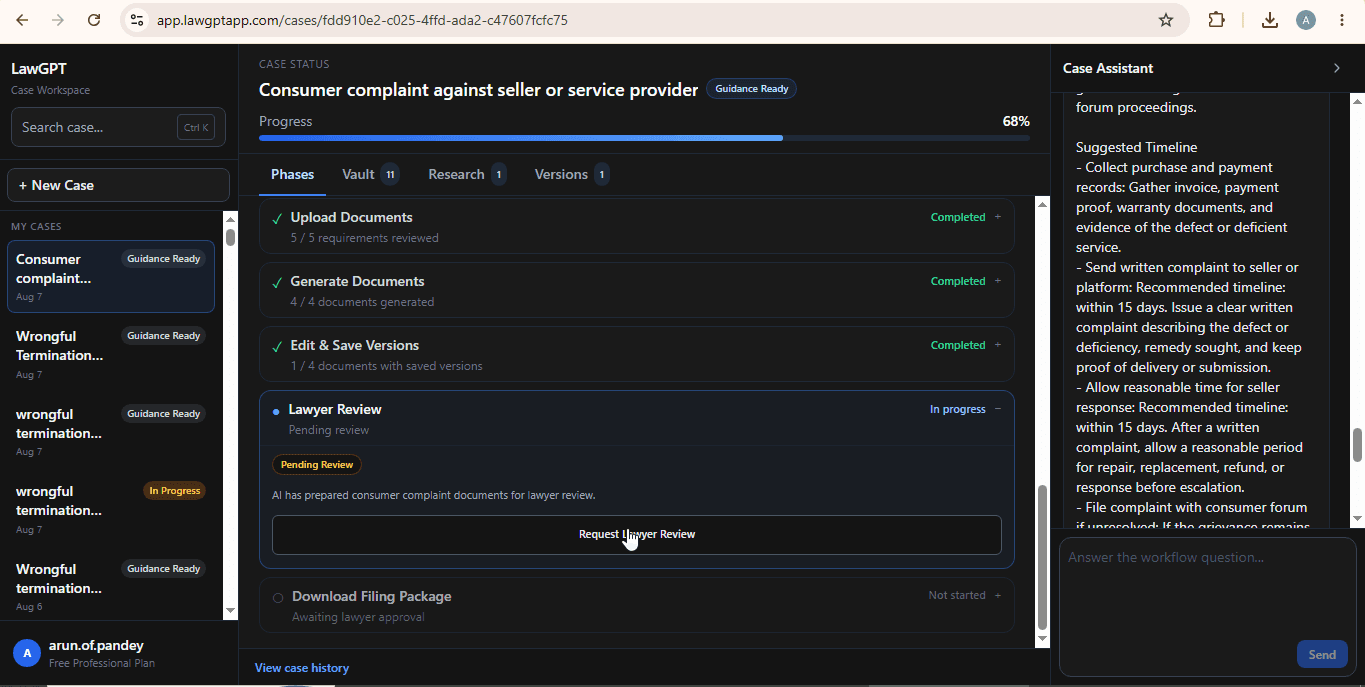
Inside the LawGPT workflow
Frequently asked questions
Yes, consumers may appear in person. Complex matters—especially with multiple e-commerce respondents—benefit from drafting help or optional lawyer review.