
Criminal procedure
FIR Refusal and the Magistrate Process: What to Expect Before Going to Court
An educational map of the Magistrate route after police escalation: preparation, jurisdiction, sworn material, court options, and post-order discipline.
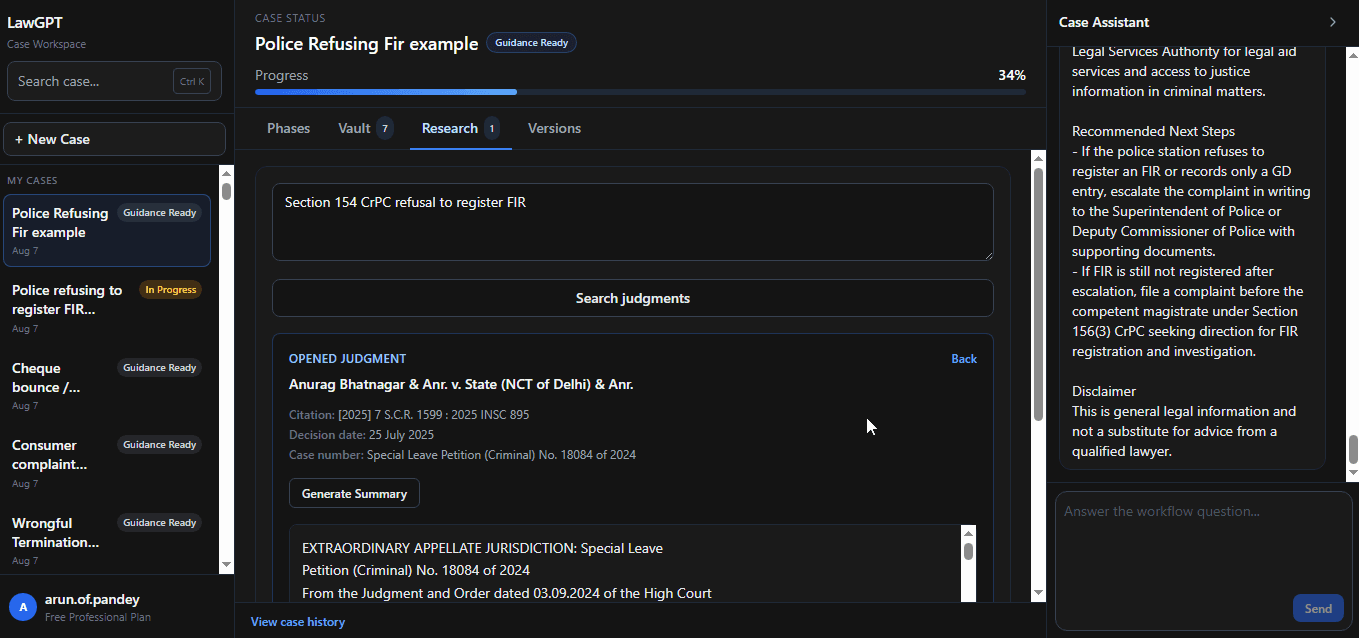
When police-level remedies have not resolved a serious complaint, people often say they will “go to the Magistrate for FIR.” That phrase hides important choices. The court, applicable criminal-procedure statute, territorial facts, prior representations, nature of evidence, and relief requested all matter. A competent advocate will assess whether a statutory application seeking an investigation-related direction is appropriate, whether a private complaint route is more suitable, and whether urgent protection or another specialised remedy is needed.
Do not regard court as an automatic appeal from a rude counter interaction. Courts need a coherent record showing facts, prior police approach, material supporting the allegation, and legal basis for the request. They may call for a report, take cognizance through a different path, defer, issue directions within their powers, or dismiss an insufficient application. The exact procedure varies and must be verified under current BNSS/CrPC transition law and local court rules.
What your advocate needs before drafting
Court-consultation bundle
- Station complaint and every version sent
- Acknowledgements, postal tracking, and refusal chronology
- One-page case timeline
- Legible annexures with source/date notes
- Witness list stating what each person personally knows
- Any urgent-risk, medical, or preservation material
- Correct addresses and jurisdiction facts
Jurisdiction is more than the location of a police station. Counsel will ask where each material act occurred, where a digital communication was sent and received, where loss or injury occurred, and whether a special statute identifies a forum. Give the full geography—even facts you think are inconvenient. A filing in the wrong court can waste precious time; a carefully supported jurisdiction explanation can prevent avoidable objections.
Sworn statements, affidavits, verification, and annexure requirements differ by route and court. Sign only after reading the final draft in a language you understand. A verification is not ceremonial: it tells the court you stand behind the facts. If you cannot verify a point from personal knowledge, say where it came from and whether a supporting witness or record exists. Do not turn a lawyer's legal argument into a false factual assertion in your name.
| Court question | Why it is asked | Helpful preparation |
|---|---|---|
| What offence is disclosed? | Determines legal pathway | Fact-specific narrative and records, not copied sections. |
| What did police do first? | Shows prior approach | Dated complaint and delivery proof. |
| Why this court? | Tests jurisdiction | Map of locations, digital events, residence, and harm. |
| What evidence may disappear? | May inform urgency | Specific CCTV, account, device, or witness details. |
Possible stages after filing
After filing, the registry may scrutinise papers, a court may hear preliminary submissions, and the matter may be posted for orders or a report. Do not assume the first listing decides everything. Keep a calendar, obtain the case number once available, retain stamped copies, and ask counsel what attendance is required. If the court directs a report or calls for further material, respond through counsel rather than sending informal messages to the judge, court staff, or police.
An order should be read line by line. It may contain a direction, a request for a report, a complaint-process step, a next hearing date, or conditions for compliance. It is not safe to summarise an order as “the judge ordered FIR” until counsel has read the operative text and confirmed what the police or complainant must do. Preserve certified or authenticated copies as required; screenshots of a cause list are not substitutes for an order.
Costs, timing, and expectations
There is no honest universal timeline. Court workload, service, police reports, witness availability, statutory urgency, and local rules affect pace. Ask your advocate for a case-specific schedule and what must happen before the next date. Budget for copies, travel, lawyer fees, and time away from work, but do not choose a forum solely because someone promises same-day registration. A promise of a guaranteed order is a warning sign.
Maintain separation between the court case and negotiations with the other side. If settlement discussions happen in a matter where they are lawful and safe, tell counsel. Do not exchange “withdrawal” promises, money, or admissions in private messages without advice; they can affect both safety and the record. Some allegations cannot be privately settled in the way parties imagine.
A court filing must be complete and candid
Before any Magistrate route, tell counsel about every prior station visit, senior-officer submission, compromise discussion, related civil matter, and known weakness in the evidence. The court needs a coherent history, not a selective one. Bring dates, addresses, source records, and the precise relief you seek advice about. Do not use an affidavit, verification, or sworn statement to repeat an assumption as if it were personal knowledge.
A filing should also explain urgency without exaggeration. If CCTV, account data, a witness, or safety is at risk, identify the source and time window. A vague assertion that “all evidence will be destroyed” is less useful than a factual preservation concern that counsel can frame lawfully.
Court orders require careful reading
After each listing, obtain the order or authenticated information through the proper channel and ask counsel what it actually directs. A next date, report call, verification step, or procedural order is not automatically a final decision on registration or investigation. Calendar the date, preserve proof of compliance, and do not contact a judge, registry staff, or police informally to argue the merits.
If circumstances change—new threat, new evidence, relocation, medical emergency, or a contact by the other side—tell counsel promptly. The correct response may be a lawful application, a supplement, safety support, or simply an updated chronology; it should not be a private attempt to influence witnesses or proceedings.
Use the workflow as a briefing tool
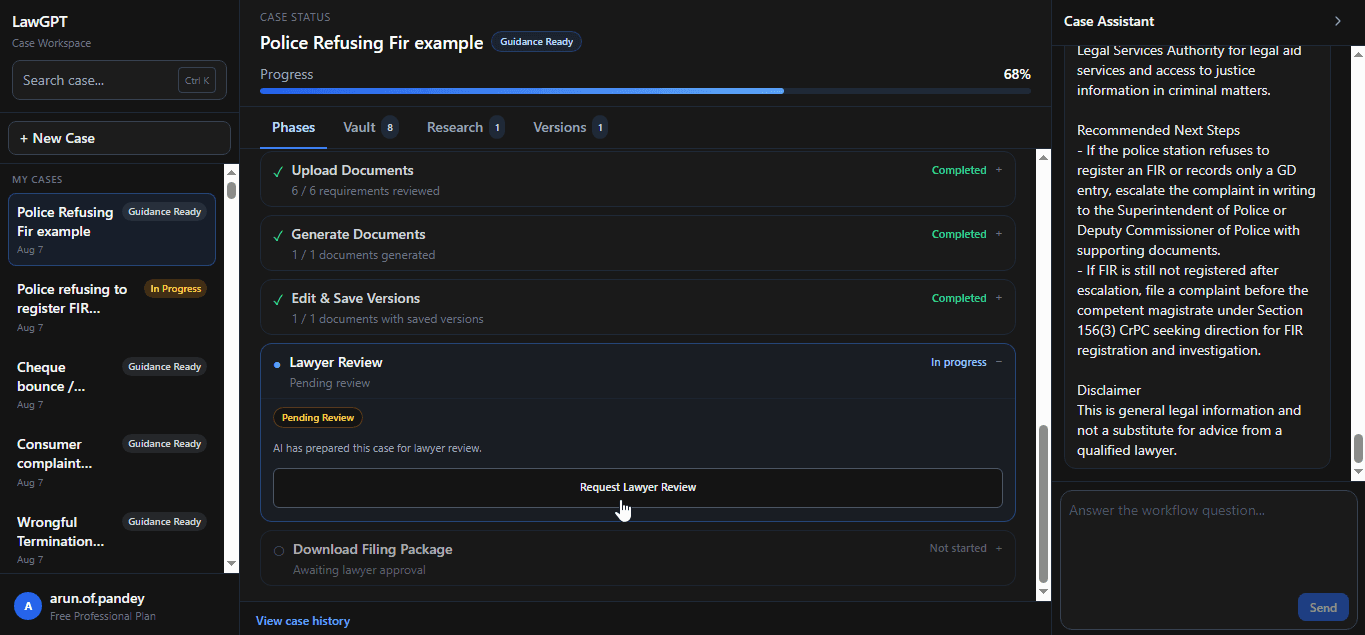
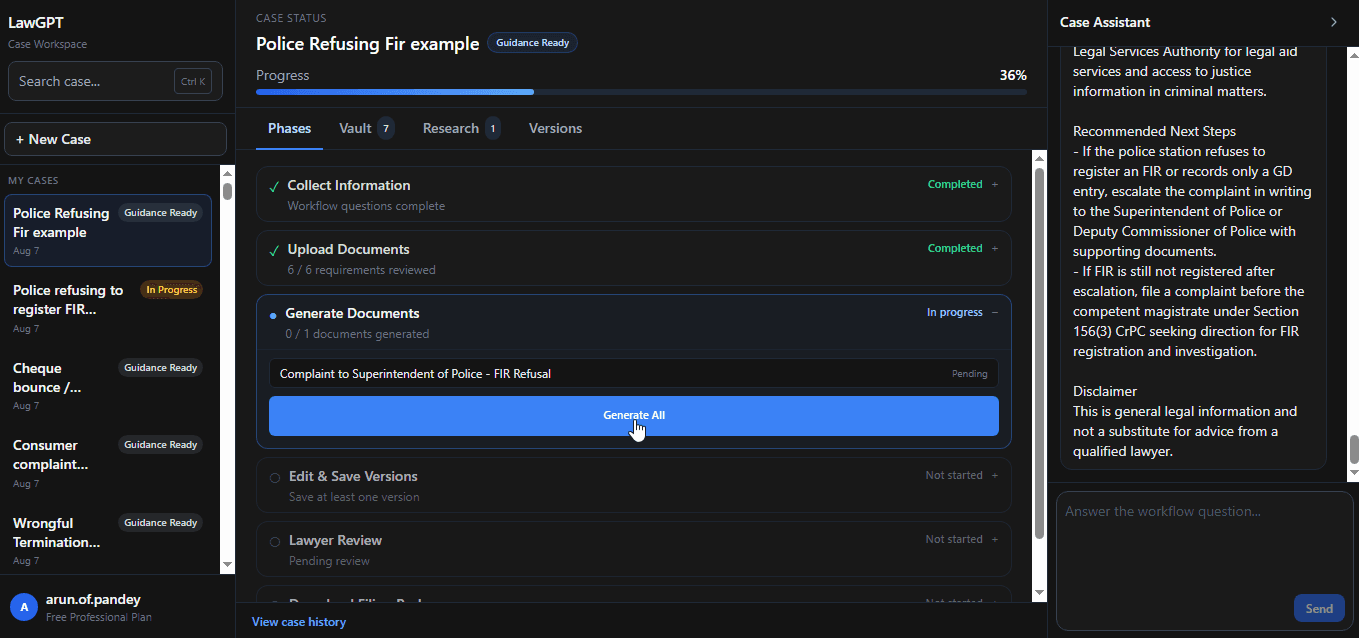
The Police Refusing FIR workflow can help turn scattered evidence into a chronology, annexure list, and advocate-briefing packet. It cannot file in court, select a legal provision for your case, or predict a judicial order.
Inside the LawGPT workflow
Frequently asked questions
People may have procedural rights to appear themselves, but a court route is technical. Professional advice is strongly advisable, especially in serious or urgent matters.