
Criminal procedure
Police Refusing FIR Explained: Why It Happens and What Lawful Options Exist
A plain-English explanation of FIR refusal, cognizable versus non-cognizable information, jurisdiction, evidence gaps, senior-police escalation, and court remedies.
“Police refused my FIR” is a conclusion; the legal system needs the underlying event. Did staff refuse to receive a complaint? Did they record a non-cognizable entry? Did they say the allegations are civil? Did they direct you to another station? Did they ask for missing details? Each can feel like a rejection, but each has a different practical answer. The common thread is documentation: keep an accurate account of what happened at the station and a stable copy of what you reported.
An FIR is connected with information relating to cognizable offences, where police may have powers and duties that differ from a non-cognizable matter. The distinction does not turn on the complainant's preferred label. It turns on statutory law and concrete allegations. A bad cheque, contract breach, family argument, or online insult may require careful legal analysis; simply using words such as fraud, threat, or harassment is not enough. Conversely, a dispute called “civil” can contain facts that require criminal-law attention.
Why an officer may not register immediately
- The facts given may be too vague to identify an alleged offence or investigation lead.
- The station may say another area has territorial connection and should handle the matter.
- The officer may classify information as non-cognizable or civil in nature.
- Documents may be incomplete, disputed, or require verification under the applicable procedure.
- The interaction may simply be mishandled—which is why a traceable written escalation route matters.
None of these explanations authorises a complainant to invent missing facts. Improve clarity instead. Give a date range if you cannot know an exact time, mark an amount as approximate if it is not final, and explain why a document is unavailable. Identify people by name, phone number, account handle, vehicle number, or physical description only to the extent you genuinely know them. A careful unknown is better than a confident false identification.
The lawful response in plain English
First, create a written complaint that a stranger can understand. Second, seek a receiving or record your attempt. Third, if station-level action is deficient, send the same core packet to the appropriate senior police authority with an annexure index and delivery proof. Fourth, obtain advice about a Magistrate application or other suitable remedy if needed. Throughout, preserve evidence and prioritise safety. This is an escalation ladder, not a guarantee that every complaint becomes an FIR.
Use words that invite lawful review: “Please consider the enclosed information and take action in accordance with law,” “Please preserve CCTV at [location] for [time range],” and “Please inform me of the reference number or appropriate station.” Avoid words that promise facts you cannot prove or demand a predetermined investigative conclusion.
| Concept | Plain meaning | Your job |
|---|---|---|
| Cognizable information | Allegations that may trigger the FIR/investigation framework | State material acts accurately. |
| Jurisdiction | Which police station/court has geographic connection | Give all relevant locations. |
| Escalation | Senior review of a deficient station response | Send a consistent, traceable packet. |
| Magistrate route | Judicial process under applicable procedure | Take current, case-specific legal advice. |
| Evidence preservation | Stopping genuine proof from being lost | Protect originals and identify risk. |
What this guide cannot tell you
It cannot decide whether your facts establish an offence, whether police are entitled to conduct a preliminary step, whether an arrest should occur, whether a court will grant a request, or which procedural provision controls your case. Those answers require current law and a full factual record. Be cautious of any person who answers them from a one-line message or offers to manage a station for cash.
It also cannot replace emergency assistance. If there is immediate violence, stalking, threat, or medical need, contact emergency services, move to safety, and seek urgent support. Preserve details when it is safe to do so; do not remain in danger to collect proof.
A better first consultation
Bring this to your advocate
- One-page incident and station chronology
- Copy of every complaint/version
- Proof of each delivery attempt
- Key evidence in original and readable copy
- Names of witnesses and what each knows
- Current safety concern and evidence-loss risks
- Questions about jurisdiction and next remedy
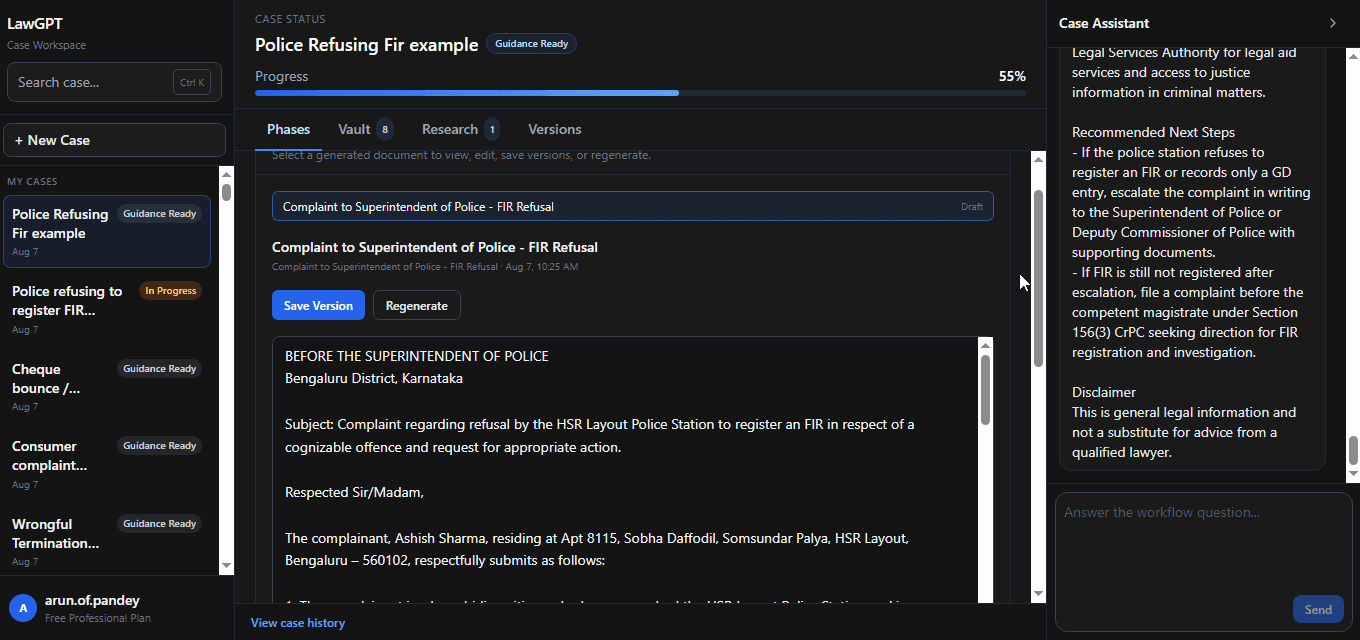
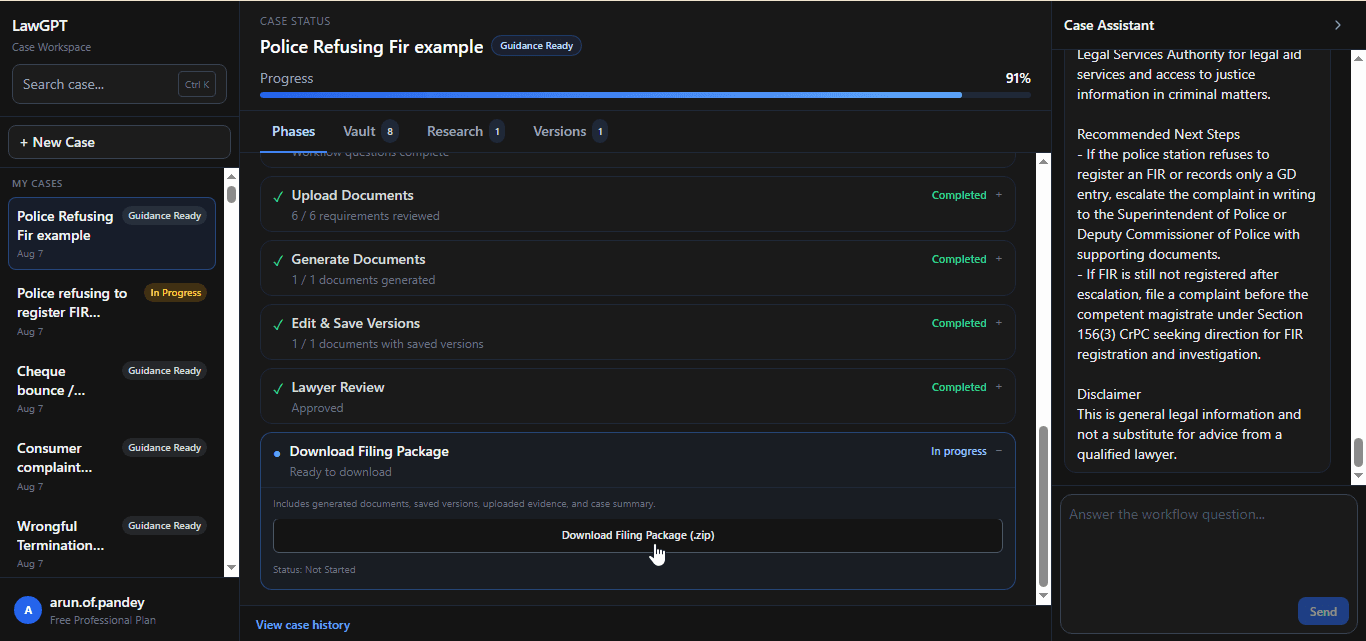
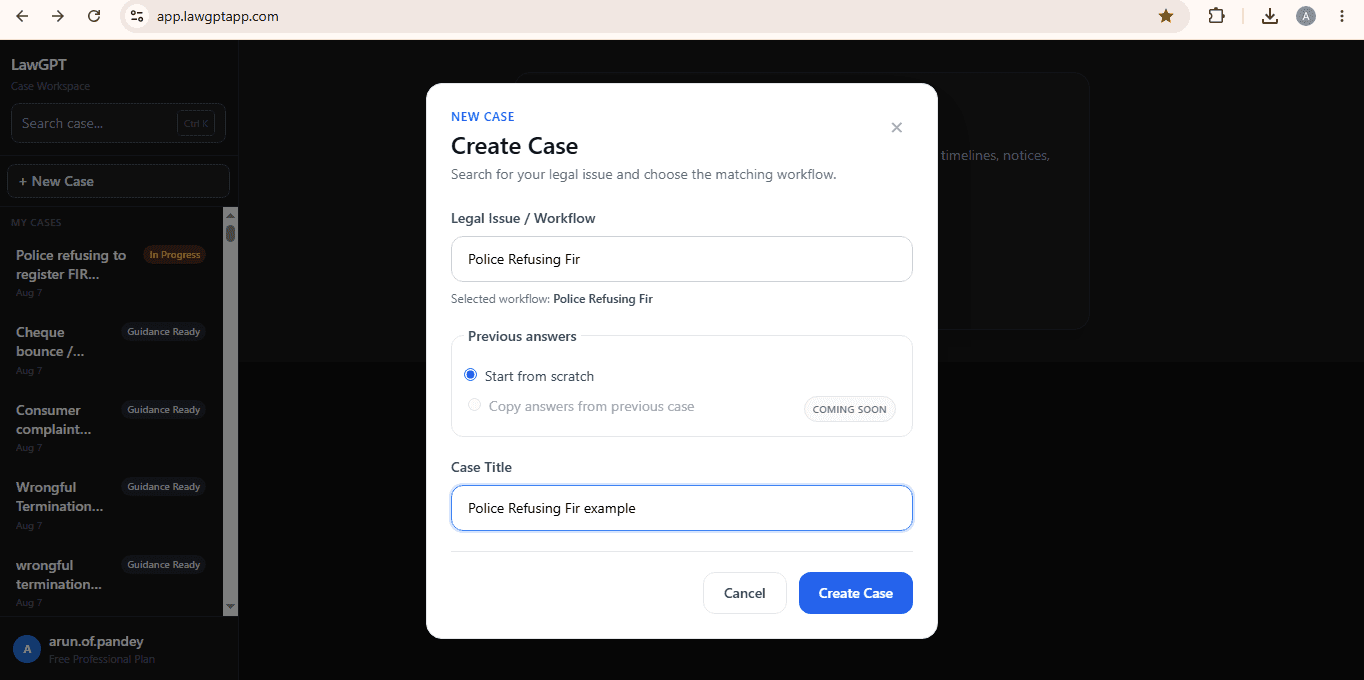
The Police Refusing FIR workflow helps convert your story into a structured intake, document list, senior-officer draft, and downloadable package. Its role is preparation. The decision to file, the choice of forum, and representation remain yours and your lawyer's.
A refusal is information, not a final verdict
A difficult station interaction may reveal a classification question, a jurisdiction problem, a missing fact, poor communication, or deficient handling. It does not by itself prove that the allegation is false, that an officer is corrupt, or that a particular court outcome will follow. The disciplined response is to record the event accurately and use the next lawful route with the same stable core facts.
That discipline also helps if the matter later involves an advocate, senior police officer, Magistrate, insurer, employer, or support organisation. Each can understand what happened without sorting through changing stories and unlabelled screenshots.
Keep the objective realistic
The objective is not to force a predetermined label, arrest, or result. It is to place accurate information before the competent authority, preserve material that may be lost, address immediate safety, and obtain advice on the remedy the law allows. Courts and police make decisions through lawful processes, and an organised complainant can participate more effectively without exaggeration or public pressure.
Use a workflow or checklist to prepare for a consultation, then rely on official directions and tailored professional advice for the live matter. That balance respects both the seriousness of a genuine complaint and the need for fair procedure.
Inside the LawGPT workflow
Frequently asked questions
No. It may reflect classification, jurisdiction, missing information, or handling. Preserve facts and seek the correct remedy.